

A look at the rise of social-media physicians like “Dr. Piriton UG,” and the harder questions their popularity has started to raise about credibility, oversight, and who gets to be a trusted voice on health in Uganda.
- Advertisement -
For generations, a great deal of intimate health and relationship advice in central Uganda passed through one particular figure: the senga, a paternal aunt traditionally tasked with counseling young women on marriage, sexuality, and household matters. The role is old, culturally specific, and in many communities still taken seriously. It has also, increasingly, become a target of criticism. A 2025 Daily Monitor feature ran under the headline “Many ssengas are feeding ladies with misinformation,” a blunt summary of a complaint now voiced by doctors, journalists, and younger Ugandan women alike: that some of the guidance passed down through this informal channel — on fertility, contraception, sexual health, and hygiene — is outdated, medically unfounded, or actively harmful.
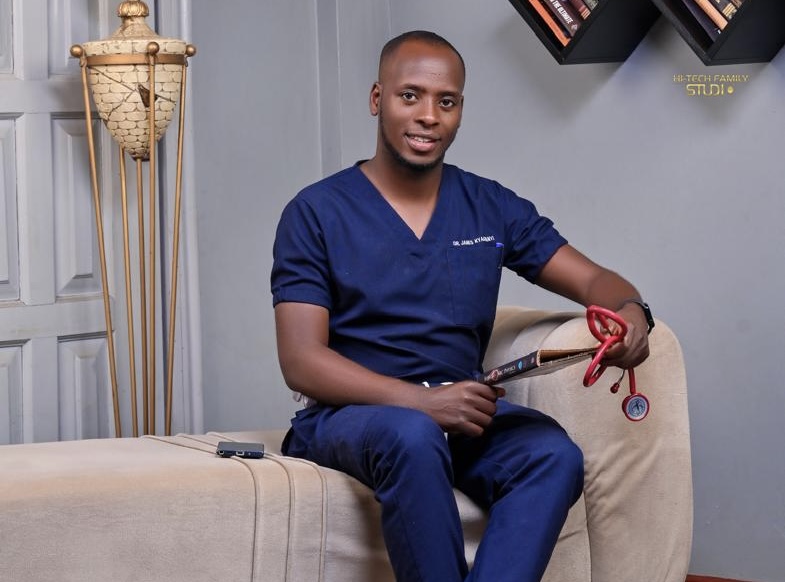
That same article, notably, used the rise of a very different figure as its counterpoint and case study: James Kyagulanyi, the Makerere-trained physician known online as Dr. Piriton, whose TikTok, YouTube, and Facebook channels have made him arguably Uganda’s most visible source of free, public health information. The juxtaposition is pointed. One figure represents an old, informal authority now under suspicion. The other represents a new, informal authority that has grown explosively precisely by promising something more reliable. Whether it actually delivers that reliability, at scale, to an anonymous audience of millions, is the question this piece sets out to examine — and it is a harder question than the framing of “doctor versus aunty” makes it sound.
A Vacuum, Filled Quickly
The context that makes any of this possible is, by now, well documented. Uganda trains roughly 1,000 new doctors a year, according to estimates from the African Centre for Global Health and Social Transformation, against a population approaching 50 million. The country’s doctor-to-patient ratio is commonly put at around 1 to 25,000 — a small fraction of the World Health Organization’s recommended 1 to 1,000 — and its nurse-to-patient ratio at roughly 1 to 11,000. In large parts of the country, particularly outside Kampala, the nearest in-person source of reliable medical guidance can be a significant journey away, in time and money both.
Social media did not create that vacuum, but it has rushed to fill it, in Uganda as in much of the world. Where older generations relied on relatives, traditional advisors, or whichever neighbor happened to have trained as a nurse, a newer generation increasingly turns first to a phone. The format rewards confidence, brevity, and a recognizable face — which is precisely what figures like Dr. Piriton supply. He built his following, by his own account, after studying how doctors elsewhere had already mastered the format: an American family physician known for approachable explainers, a California dermatologist whose diagnostic clips went viral internationally, a British surgeon who specializes in myth-busting for a young audience. The lesson Kyagulanyi appears to have taken from all three is that medical trust online is manufactured through volume and personality as much as through credentials — and he applied it efficiently, branding himself after a well-known headache and allergy tablet rather than practicing under his own name.
The Verification Problem
Here is where the comparison to the senga becomes genuinely useful, rather than just a clever headline. Part of what makes the criticism of ssengas land is that the role carries no formal accountability: there is no licensing body for sengas, no register to check, no mechanism for revoking the title if the advice given turns out to be wrong. Critics argue that a similar accountability gap has simply moved onto a new platform.
Kyagulanyi’s defenders would object, correctly, that he is not a self-appointed cultural authority but a credentialed one: graduated from Makerere’s College of Health Sciences in 2023, by his own account interned at Mulago National Referral Hospital, and registered with the Uganda Medical and Dental Practitioners Council. That distinction matters, and it is the central claim on which his entire public identity rests. It is also a claim that, as far as published reporting shows, has been taken on trust from Kyagulanyi himself in every interview he has given, rather than independently confirmed against UMDPC’s public register by the outlets profiling him. That is not an accusation of dishonesty. It is an observation about how thin the verification layer is for a figure whose authority depends entirely on the public believing he has it — a thinness that, ironically, is exactly the structural problem critics raise about the sengas he is implicitly contrasted against.
It is also worth noting that Kyagulanyi has, in at least one instance, taken it upon himself to police that very boundary. In a widely shared video, his account accused an unidentified individual of falsely posing as a doctor at Mulago Hospital and charging patients for services that are supposed to be free there. The video racked up tens of thousands of likes. But the accusation was made on his own platform, against someone not clearly identified in the available footage, and — as far as can be determined — was not independently investigated or confirmed by the hospital, by UMDPC, or by any news organization. If credibility in this space is policed mainly by other influencers calling each other out, rather than by any formal regulatory process, then the system has effectively replaced one unaccountable authority with another, just with better production values.