

President Yoweri Kaguta Musevenitoday led Ugandans in commemorating the 49th anniversary of Archbishop Janani Luwum’s martyrdom in Kitgum District, honoring his courage, faith, and ultimate sacrifice during the brutal regime of former dictator Idi Amin.
- Advertisement -
The President was accompanied by the First Lady and Minister of Education and Sports, Maama Janet Kataaha Museveni.
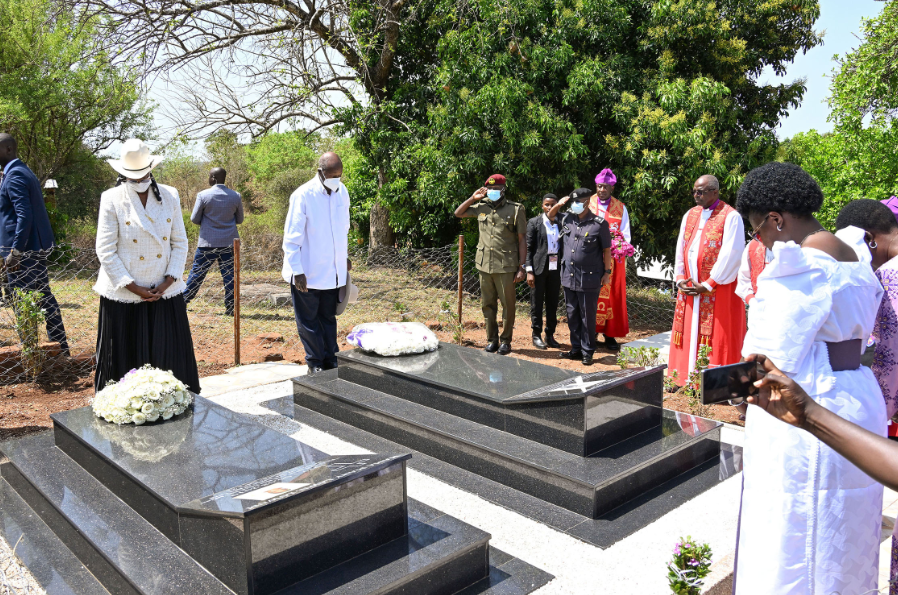
The National Event, under the theme “Anchored in Christ for Stability, Peace and Unity” (Ephesians 2:14–17), began with a main church service before the President and the First Lady laid wreaths at Wii-Gweng in Mucwini, the final resting place of Archbishop Luwum and his wife, Mama Mary Lawil Luwum.
St. Janani Luwum Day, observed every February 16, honors the Archbishop who was killed in 1977 after openly condemning human rights abuses, arbitrary arrests and killings during Amin’s regime.
In his address, President Museveni said Ugandans had gathered to honor Luwum’s unwavering faith and courage as well as to reflect on the dangers of authoritarian rule.
He described Amin’s first mistake as imposing himself on the country through military force in the 1971 coup.
President Museveni, who was then serving as a research assistant in the President’s Office, recalled that on January 25, 1971, learned of the coup while preparing to go to work from his place in Kireka at that time.
After confirming the news that Amin had taken power, President Museveni narrated that he contacted some student leaders and resolved not to accept the new regime. Within two days, he withdrew money from the bank and left for Tanzania with four others to begin organizing resistance.
“Amin ruled me only for a few hours,” President Museveni said, emphasizing that leaders should not impose themselves on citizens but instead persuade them through good services.
He cited biblical teaching, saying leaders must let their good deeds shine before others.
He warned that any leader who relies on intimidation mirrors the same mistake Amin made.
The President described Amin’s second major mistake as using killings to silence opponents.
While acknowledging Uganda’s history of armed struggle, President Museveni said he has consistently rejected assassinations and attacks on individuals outside the battlefield.
He recalled rejecting a proposal by some fighters to assassinate then–army commander Oyite Ojok in his home, insisting that such actions would amount to cowardice.
Even in conflict, he said, both the cause and the methods must be just.
President Museveni said he remains satisfied that those responsible for atrocities during Amin’s regime ultimately failed in their mission, noting that the sacrifices of leaders such as Luwum and Ben Kiwanuka were not in vain.
Turning to development, President Museveni thanked the people of Northern Uganda for their electoral support, attributing it to sustained government efforts in infrastructure and service delivery. He cited the extension of electricity beyond Lira, improved roads, schools, health centers and clean water systems that helped eliminate diseases such as guinea worm.
According to the President, national efforts to move households into the money economy have significantly reduced poverty levels, with programs such as the Parish Development Model targeting the remaining households still outside the cash economy.
He also pledged to address reports of cattle rustling in East Acholi, saying the matter would receive his personal attention.
The President also fulfilled his Shs60 million pledge to the Priests of Kitgum Diocese.