

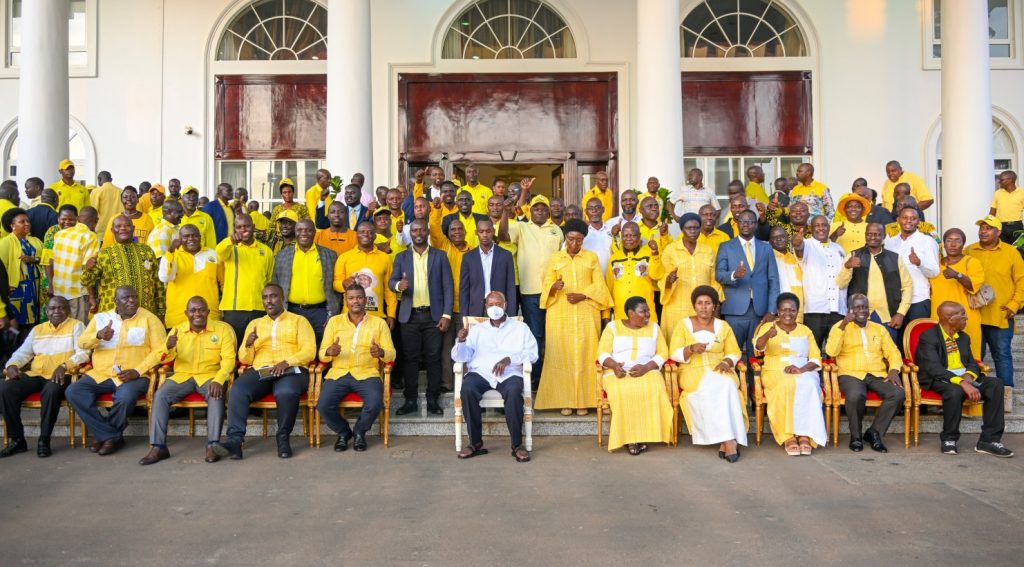
President Yoweri Kaguta Museveni yesterday evening met with the National Resistance Movement (NRM) Chairpersons for districts, cities, municipalities, and divisions at State House Entebbe.
- Advertisement -
During the meeting, President Museveni, who is also the National Chairman of the NRM, congratulated the leaders upon their victory in the recently concluded elections.
The President also noted that he detected greater national cohesion in the recent elections compared to previous cycles, likening it to the unity witnessed during the 1996 elections, where, he noted, the population strongly rallied behind the NRM due to its problem-solving approach.
He explained that this cohesion was built on what he described as “okukyenura” — leadership that responds to people’s needs — citing the restoration of security through a disciplined army and the stabilization of essential commodities such as sugar in the early years of NRM governance.
The President said that after 1996, new challenges such as household poverty became more visible, prompting the introduction of revolving funds at sub-county level in 1997 to support wealth creation. He noted that subsequent interventions, such as NAADS were rolled out to distribute seedlings and boost agricultural productivity, though a significant percentage of the population remained outside the money economy.
This, he said, led to the introduction of the Parish Development Model (PDM), designed to send funds directly to beneficiaries and empower parish committees to determine allocation transparently. He observed that PDM is performing well in some districts and more funding will be added to enhance its impact, thus urging party leaders to closely monitor its implementation.
On education, President Museveni said the NRM foresaw a looming crisis and introduced free education to expand access, but expressed concern over what he termed as sabotage by some teachers, as well as insufficient oversight by leaders.
He also raised concerns about corruption, particularly within some District Service Commissions accused of selling jobs, cases of land grabbing, and theft of medicines from government health facilities. He urged NRM leaders to intensify supervision and ensure accountability.