

President Yoweri Kaguta Museveni has said the National Resistance Movement (NRM) party has fundamentally transformed Uganda from an import-dependent economy into one increasingly driven by domestic production, manufacturing, and wealth creation.
- Advertisement -
Addressing thousands of NRM supporters at the Makerere University Business School (MUBS) grounds in Nakawa Division on Wednesday, January 7, 2026, President Museveni said industrialisation, expanding manufacturing, and promoting wealth creation remain the cornerstone achievements of the NRM government and the basis upon which the party deserves another mandate.
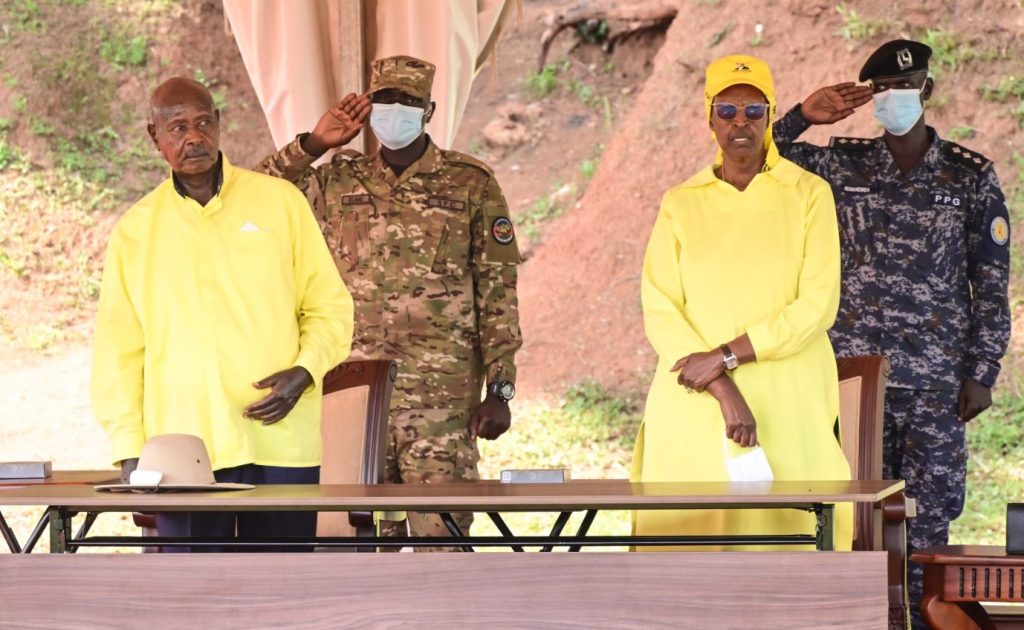
The President, who was accompanied by the First Lady and Minister of Education and Sports, Maama Janet Kataaha Museveni, used the campaign rally to directly challenge critics who claim the NRM has done little to transform the country.
“Somebody told me yesterday that if you went to the supermarket today, you would find that 65 percent of the products are made here. In the past, 95 percent of the products in the supermarkets were imported,” President Museveni said, drawing cheers from the crowd.
He added that the shift towards domestic production is evidence of structural economic change, insisting that those who deny the NRM’s contribution are being dishonest.
“Those saying that the NRM has done nothing deserve hell,” President Museveni said, before elaborating on what he described as hypocrisy among critics.
“So, anybody who stands and says that NRM has done nothing will go to hell—Geyena in Luganda. Because Jesus doesn’t like hypocrites. Especially, Jesus had a lot of problems with the Pharisees, who were pretending to be religious but were hypocrites. He said you’re like graves—white outside but rotten inside,” the President remarked, drawing laughter and applause.
The NRM candidate placed particular emphasis on manufacturing and artisanship as critical engines of wealth and employment, citing the rapid expansion of industrial parks across the country as tangible proof of economic transformation.
He pointed to Sino-Uganda Mbale Industrial Park, which he said hosts about 75 factories employing approximately 12,000 workers, and Namanve Industrial Park, Uganda’s largest, which currently accommodates 273 factories employing more than 24,000 people.
“That area (Namanve) was a forest, and that’s where they used to throw dead bodies during the Idi Amin regime. But now it’s all full of factories,” President Museveni said.
He returned to his earlier criticism of the opposition, insisting that the existence of such factories invalidates claims that the NRM has failed to deliver.
“So, with those factories and all that wealth, and you say NRM has done nothing, I feel very sorry for you because I can see hell is waiting for you,” he added, in remarks delivered with humour that elicited laughter from supporters.
Wealth creation:
The President emphasized that wealth creation remains a central pillar of national stability, arguing that infrastructure such as roads and schools, while important, cannot sustain a country whose citizens remain poor.
“The NRM from the 1960s clarified that you can have roads and schools, but if you are not rich, you will retard and eventually collapse,” President Museveni said.
He explained that long before taking power in 1986, the NRM had developed a clear ideological framework centred on wealth creation and job generation.
According to President Museveni, wealth and employment are primarily generated in four key sectors, such as commercial agriculture, encompassing crops, livestock, and fisheries.
“If you engage in commercial agriculture, you will create wealth and jobs. The wealth is yours, but it also creates jobs for other people,” he explained.
The second sector, he said, is artisanship and manufacturing, which transforms raw materials into value-added products and absorbs large numbers of workers.
The third sector consists of services such as hotels, transport—including boda bodas—and other service-based enterprises that generate both income and employment.
The fourth sector, President Museveni said, is Information and Communications Technology (ICT), which allows Ugandans, particularly urban youth, to work remotely for companies abroad while earning incomes at home.
“You can be here in Nakawa and work for companies in America, and they pay you here, yet the company is somewhere else,” he said.
Practical examples of commercial agriculture:
To illustrate the potential of commercial agriculture, President Museveni offered a practical example based on a four-acre model.
“You put coffee on one acre, fruits on the second acre, livestock on the third acre, and the fourth acre for crops for home consumption,” he said.
He added that farmers could supplement this with piggery—where culturally acceptable—or poultry farming in the backyard, as well as fish farming on the periphery of wetlands rather than in their centres.
“Even if you are here in the centre of town, in the periphery you can do some of these things,” President Museveni said.
The President cited the success of Johnson Basangwa, the proprietor of Jeka Poultry Farm in Kamuli District, as a powerful example of how wealth creation translates into job creation.
According to President Museveni, Basangwa produces about 2,500 trays of eggs daily, earning approximately Shs20 million per day, Shs600 million per month, and about Shs7.2 billion annually.