

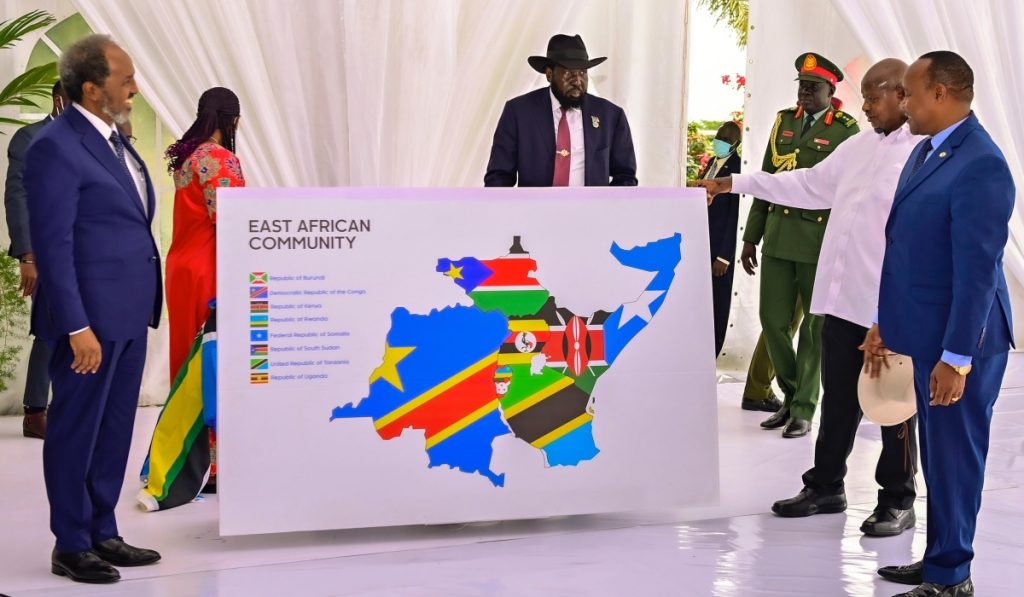
In a bold and visionary push for continental unity, President Yoweri Kaguta Museveni has placed East African integration at the heart of Uganda’s development strategy for the decade. His agenda—anchored in the principles of pan-Africanism, economic expansion, and strategic security—aims to transform the East African Community (EAC) into a politically federated bloc with a single currency and a shared constitution by 2031. This ambitious roadmap is not just a political aspiration—it’s a strategic recalibration of Africa’s place in the global order.

- Advertisement -
And it’s not just rhetoric. This entire integration blueprint is enshrined in President Museveni’s 2026–2031 reelection manifesto—a public commitment to deliver a united East Africa under one constitution, one currency, and one destiny. The manifesto outlines a series of concrete promises that position Uganda as a driving force behind regional transformation.
At the core of Museveni’s integration philosophy lies a deep ideological commitment to pan-Africanism, a principle long championed by the National Resistance Movement (NRM). The President has repeatedly emphasized that the colonial partitioning of Africa created artificially small states, many of which lack the population size and economic capacity to thrive independently. “Africa’s 1.4 billion people are broken into small units. Small populations mean small markets. Small markets mean low prosperity,” Museveni stated during a recent address to the EAC Secretariat.
- Advertisement -
Uganda, with its 46 million citizens, is one of the larger states in the region. But even Uganda’s internal market is insufficient to guarantee prosperity. Museveni draws historical parallels to the unifications of Germany in 1871 and Italy in 1860, and the economic liberalization of China and India, arguing that integration is the only path to sustainable development. Uganda’s current economic challenges—surpluses in sugar, maize, cassava, milk, and bananas—are not due to overproduction, Museveni argues, but to disorganization and limited market access. The solution? A well-functioning African free market.
The African Continental Free Trade Area (AfCFTA), ratified in 2017, is a key instrument in this vision. By removing trade barriers across the continent, AfCFTA enables Ugandan producers to access broader markets, reducing dependency on Europe or the United States. “If we mobilize the whole of Africa to remove trade barriers, we shall no longer worry about being shut out of markets in Europe or the USA,” Museveni affirmed. Infrastructure development is also central to this strategy. Uganda’s partnership with the Democratic Republic of Congo (DRC) to construct the Mpondwe-Beni highway is a prime example of regional connectivity in action.
Museveni’s integration agenda is not a solo endeavor. Leaders across East Africa have echoed similar sentiments. Kenya’s President William Ruto has been vocal about the need for a single currency and deeper integration: “We must move beyond rhetoric. A single currency will eliminate transaction costs and boost intra-regional trade. Political federation is the next logical step,” Ruto said at the EAC Heads of State Summit in Arusha. Tanzania’s President Samia Suluhu Hassan has emphasized cultural unity as a foundation for political integration: “Kiswahili is more than a language—it is our shared heritage. Promoting Kiswahili across East Africa will strengthen our identity and ease communication,” she noted during a regional youth forum. Rwanda’s President Paul Kagame has also backed the federation, highlighting its strategic value: “A united East Africa can negotiate with global powers from a position of strength. Fragmentation weakens us,” Kagame stated at the African Union Summit.