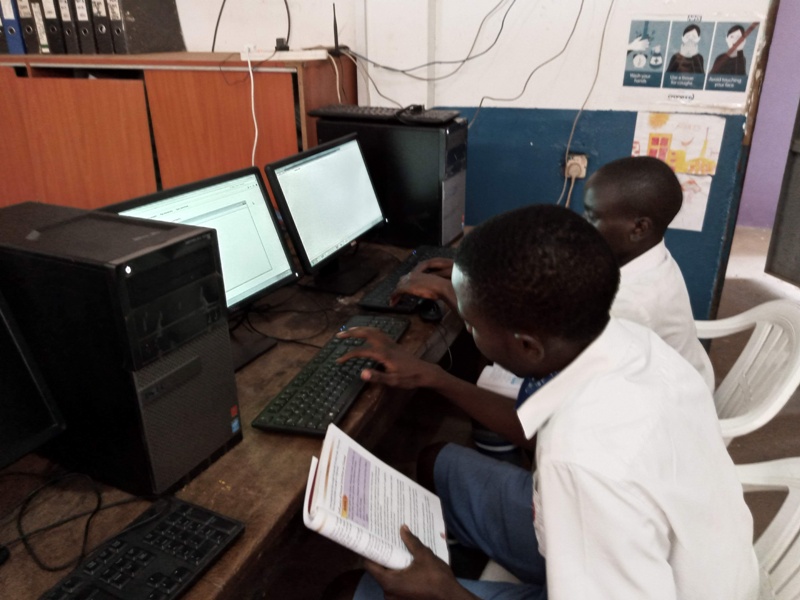

Uganda’s education is slowly experiencing a paradigm shift. New ways are replacing old ones in which learners access instructional learning materials.
Interestingly, the outbreak of coronavirus pandemic seemed to have hastened the adoption of digital learning as many schools around the world embraced online learning.

- Advertisement -
S.D.M Bat Valley Primary School located in Kampala City learners is one of the few schools that now use computers to carry out studies toenable the pupils access a various learning material easily and experience different ways of learning.
“With the help of computers, we are now in a position to access correct information quickly and in different interactive formatscompared to the time we relied only on textbooks,” said Faizal Babro, a primary 7 pupil.
“We have also learnt new computer skills, especially with the usage of Microsoft programmes.”
Babro’s teacher, Juliet Nakintu says pupils taught with the help of computers pick up skills and knowledge quickly compared to those who rely on the traditional chalkboard.

- Advertisement -
She said the availability of computers and the computer skills acquired have facilitated self-learning for most pupils.
S.D.M. Bat Valley Primary School, with a population of 400 learners, is one of the growing educational institutions that are integrating Digital in teaching to learners, courtesy of MTN Uganda.
MTN Uganda has provided fully equipped computer labs to more than 42 educational institutions at all levels – primary, secondary and tertiary- boosting learners’ digital skills and expertise to become competitive in future jobs.
The telecom has also partnered with the Ministry of Education and Sports and the Continuum Financial Group to unveil a platform called ULEARN, a self-paced e-learning platform for teachers and teacher educators countrywide, that can be accessed at zero data costs via the MTN network.
The platform which seeks to digitalize access to Teacher Education to boost access to quality education, offers a wide range of educational resources, including interactive lessons, quizzes, and videos to support the education system in delivering remote and blended learning.
Moreover, MTN grants youths undergoing its youth skilling initiatives free access to its internet during training to be equipped with digital skills.
The new digital skills are coming at the right time as they will help bridge the skills gap for future jobs. A study carried out by the International Finance Corporation, the private sector arm of the World Bank Group (WBG), in cooperation with L.E.K. Consulting in 2019 shows that more than 230 million jobs will require digital skills in Sub-Saharan Africa by 2030.
The study notes that the largest opportunities will be in business and government, though there are significant opportunities in business-to-consumer businesses.

“Digital skills must be integrated throughout education, including at a foundational level in schools, with the public sector playing a pivotal role,” the report notes.
However, one of the biggest challenges with steering ICT in Uganda’s educational institutions is unequal access to computers, electricity and internet, according to Nuffic Kortenaerkade’s study carried out in East Africa in 2021 titled “Digitalization of education in East Africa: Needs, experiences and opportunities for the future.”
The study says the country has made strides in digital transformation, with increased access to digital connectivity and digitally enabled services, but it continues to lag behind peer nations – Kenya, Tanzania and Ethiopia.
To make the situation worse, the country does not have a policy on information and communication technologies in education to scale up ICT integration into teaching and learning processes supported by deliberate investment in educational ICT equipment, software and internet connectivity for all levels of education.
James Wonyaka, a head teacher at S.D.M Bat Valley Primary says there should be a deliberate effort by both the private sector and government to ensure that information and communication technologies are incorporated into the current education to meet the current job demands.
He appealed to well-wishers to support the school with more computers so that the majority of the learners have access to information and communication skills and a quick grasp of ideas.