

A young tailor with an economics degree is building a cross-border clientele from a workshop on the edge of Kampala — and testing how far visibility can carry a business that still runs on a needle and thread.
- Advertisement -
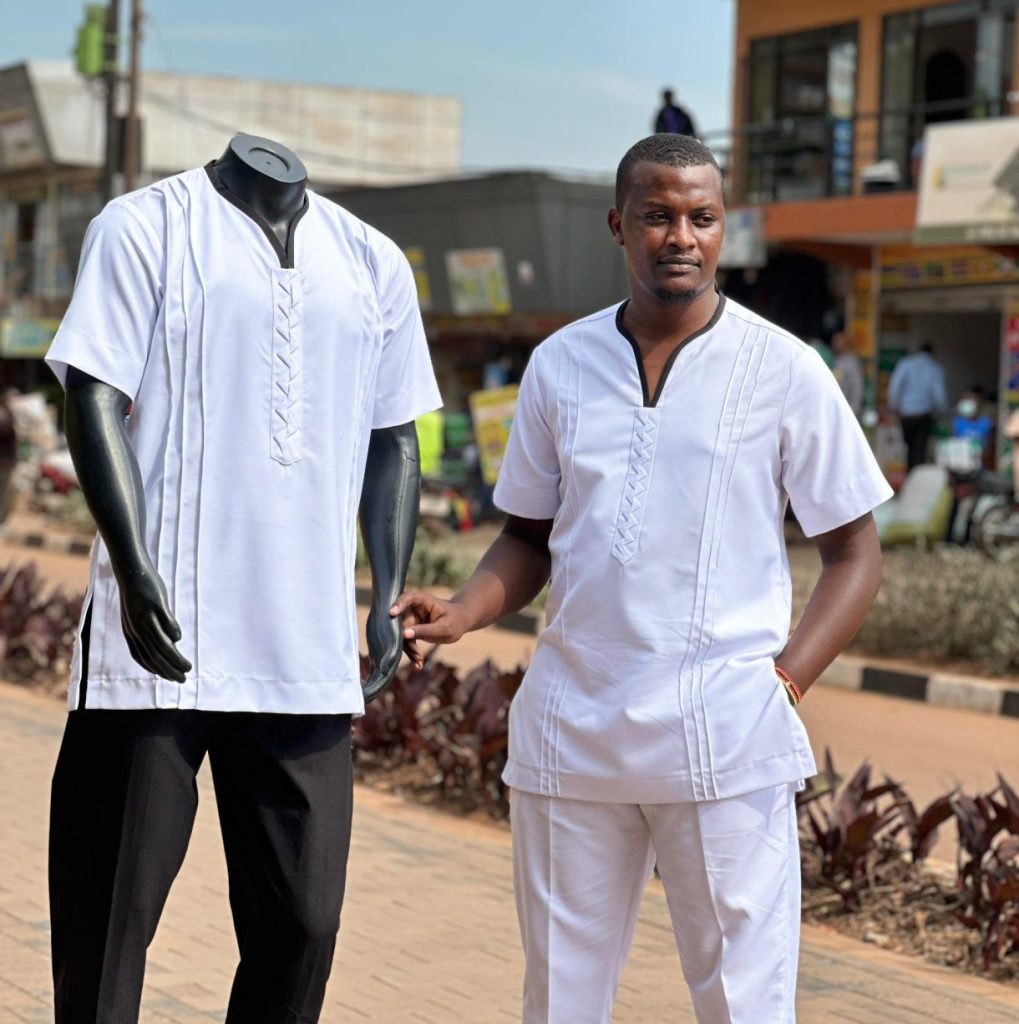
NANSANA, Uganda — In a tailoring shop in this satellite town northwest of Kampala, a young man in his late twenties pins a half-finished jacket to a mannequin, talks through what he’s doing for a phone propped on a stack of fabric bolts, and posts the result before the chalk marks have faded. The account is called Didas The Suit Guy. The man behind it, Kainamula Didas, has spent the better part of a decade turning a childhood skill into something that now reaches customers well beyond Uganda’s borders — at least according to the entrepreneur himself and the handful of outlets that have profiled him this year.
That story — rural beginnings, a trade learned at his father’s knee, a university degree layered on top, and a TikTok account that turned a one-man tailoring operation into a name recognized in several African capitals — has circulated in Ugandan and pan-African media in recent months under headlines that read more like brand copy than journalism. Strip away the superlatives, though, and what is left is a genuinely interesting case study: a 27-year-old artisan in one of East Africa’s most digitally saturated, economically constrained youth markets, trying to figure out whether a smartphone can do the work a storefront and a marketing budget never could.
It can, up to a point. The harder, less flattering part of the story is what happens at the point where a viral video has to turn into a finished, paid-for, shipped product — and that is where Didas’s experience says less about the magic of social media and more about the unglamorous infrastructure of doing business in East Africa today.
A trade learned before literacyDidas was born on October 6, 1998, in Sembabule District, a cattle-keeping region in central Uganda where tailoring was never the obvious vocation. His father worked as a tailor, and by most accounts Didas was drawn into the trade early — somewhere between the ages of six and seven, according to profiles published this year by the Nile Post and the PR distribution service IssueWire, both of which describe a childhood spent absorbing the fundamentals of garment construction by watching and helping rather than through any formal apprenticeship.That detail matters less as biographical color than as an explanation for why Didas’s content reads the way it does. Tailors who learn the trade as adults, through formal training programs, tend to narrate their process for an audience that needs each step explained. Didas’s videos move with the unconscious fluency of someone for whom hand-stitching a lapel is closer to muscle memory than performance. It is, by the account he gives in interviews and the videos themselves, a craft he has practiced for roughly two decades — longer than he has had a TikTok account, longer than he has had a university degree, and considerably longer than most of his current customers have known his name.
Whether that fluency alone explains his traction online is a separate question, and one worth treating with some skepticism. Plenty of tailors across Uganda learned the trade just as early and just as informally; Sembabule’s children have grown up around livestock and farming for generations, and tailoring families exist in most district towns. What appears to have set Didas apart is less the craft itself than the decision, made relatively early, to treat the craft as a business rather than a hobby — and later, the decision to film it.

The turn to businessAccording to multiple accounts, Didas began treating tailoring “as a business rather than a casual skill” in 2016, while he was still in Senior Six — the final year of Uganda’s secondary school system, typically completed around age 18. That timing is notable mainly because it means Didas was running a paying tailoring operation, managing customer relationships and delivery timelines, for roughly five years before he ever appeared on TikTok. The platform did not create his business. It found one that already existed.
This is a useful corrective to the version of the story that tends to circulate in promotional write-ups, which often implies that social media discovered a hidden talent. A more accurate reading is that a working tailor with several years of operating experience — pricing jobs, managing fabric costs, dealing with difficult customers, learning what made clients return — added a distribution channel that happened to be free. The skills that make a TikTok account succeed (consistency, watchability, a recognizable persona) are real, but they were bolted onto a business that had already survived the harder test of staying solvent in an informal trade for half a decade.
It is also worth noting what that five-year gap implies about risk. Didas built his customer base the slow way — word of mouth, repeat clients, a reputation earned one suit at a time — before he ever had the option of reaching thousands of viewers with a single post. That sequencing likely matters for the durability of what he has built. Businesses that scale before they have a working model tend to be fragile; businesses that find an audience after they already know how to deliver tend to hold up better when the algorithm stops cooperating.
An economist who sewsAfter completing secondary school, Didas enrolled at Makerere University, Uganda’s oldest and most prestigious public university, where he earned a Bachelor of Science in Quantitative Economics — a degree built around statistics, mathematical modeling, and data analysis, not fashion or design. It is an unusual pairing, and most of the coverage of Didas leans on it heavily, framing him as proof that craftsmanship and analytical training can coexist.
That framing is not wrong, but it deserves a more grounded explanation than “data-driven tailor,” a phrase that has appeared, with minor variations, in nearly every published profile of him. Between 2021 and 2022, while presumably still a student or recent graduate, Didas worked in a data-related role with the Mbuya Community Health Initiative, a Kampala-based organization. That experience — handling structured data, working inside an organization with reporting requirements and accountability structures — is plausibly where the “analytics” half of his identity actually solidified, separate from anything taught in a classroom.
What the degree appears to have given him, more concretely than any specific technical skill, is comfort with the kind of decision-making that small business owners in Uganda’s informal sector often have to do without formal training: pricing strategy, customer segmentation, thinking about a market in aggregate rather than one client at a time. Whether a quantitative economics degree was necessary for that, or whether five years of running a tailoring business would have taught the same lessons through trial and error, is genuinely unclear — and the existing coverage of Didas doesn’t really attempt to answer it. It is, instead, simply a useful and marketable biographical detail: a “data-trained” tailor sounds more interesting to an editor than just a tailor.
Building a following without a budget — in a country built for itDidas’s TikTok strategy, such as it is, appears straightforward: post the process, not just the product. His content shows garments being measured, cut, and assembled, rather than polished final shots of finished suits on models — an approach that several outlets have credited with making his account feel more authentic than the aspirational styling content that dominates much fashion-adjacent social media.