

Frank Bulira Kabinga, a former 2026 presidential candidate and leader of the Uganda Federal Democratic Organization (UFDO) and the Revolutionary People’s Party (RPP), has questioned the whereabouts and use of funds allocated to the Inter-Party Organisation for Dialogue (IPOD).
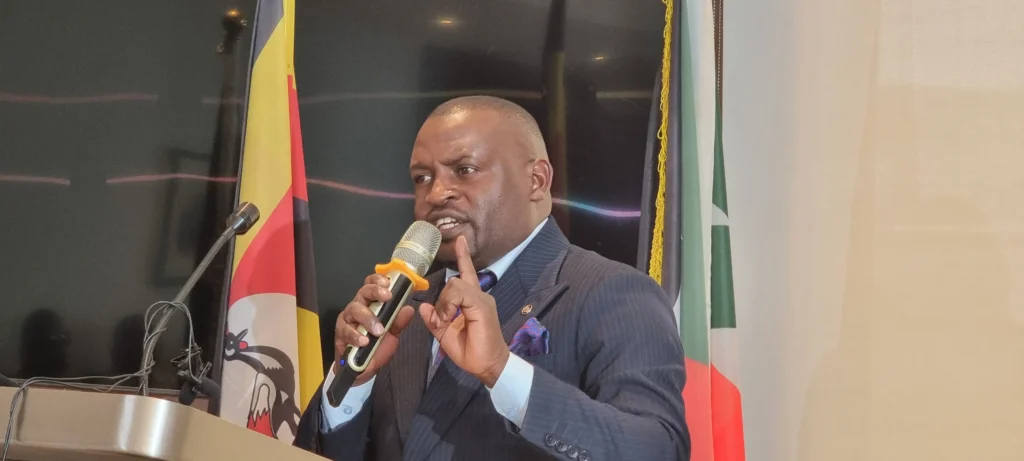
Frank Bulira Kabinga, a former 2026 presidential candidate and leader of the Uganda Federal Democratic Organization (UFDO) and the Revolutionary People’s Party (RPP)
- Advertisement -
Bulira urged opposition parties to withdraw from IPOD, accusing the platform of operating under President Yoweri Museveni’s influence while claiming to represent opposition interests.
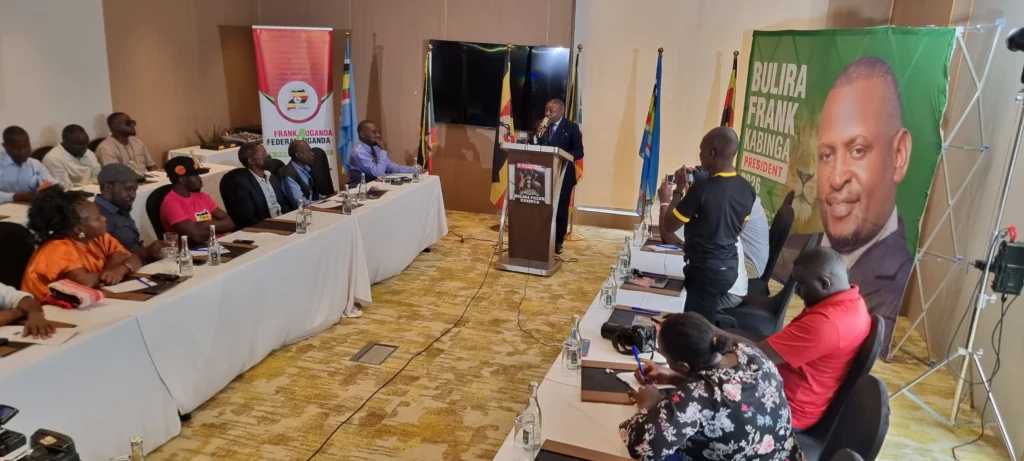
Addressing a press conference at the Sarovar Portico Hotel in Kampala on November 13, 2026, where he addressed opposition politics, national dialogue, and rising fuel costs , Bulira also stated that Uganda risks political instability if the proposed Consociational Democracy Agreement—promoted by Gen. Salim Saleh and Prof. Ogenga Otunnu—does not include key governance reforms. He called for presidential term or power limits, a non-partisan military, and the release of political prisoners as preconditions for the power-sharing proposal to work.
 3
Bulira stated that the government must first release political detainees—specifically naming Dr. Kizza Besigye and Kampala Lord Mayor Erias Lukwago—and allow exiled politicians to return safely before meaningful reconciliation talks can happen.
Bulira warned that Uganda risks political instability if the proposed agreement fails to address key governance reforms, including limits on presidential powers and establishing a non-partisan military.
He urged the government to intervene in rising fuel costs ahead of the festive season. He warned that higher transport fares are driving up commodity prices and reiterated his party’s push for a federal governance system that gives oil-producing regions greater control over local resources.
He argued that adopting a federal system would allow oil-producing regions like Bunyoro to manage 80% of local oil revenues while remitting 20% to the central government, which he believes would help shield citizens from fuel price spikes.
Bulira—who finished fifth in the January 2026 presidential election under the Revolutionary People’s Party (RPP)—announced plans to embark on a nationwide mobilisation tour to engage citizens on economic and political issues.
FULL STATEMENT
Fellow Ugandans and members of the press, good morning.
Our country, Uganda, is standing at a very dangerous crossroads today, and we are facing a deep crisis that can easily push us into chaos.
Look at what is happening to our constitutional governance. The constant arresting and putting prominent opposition leaders in prison is destroying our democracy. We see veteran leaders like Dr. Kizza Besigye facing treason charges in civilian and military courts while suffering in detention, and National Unity Platform (NUP) leader Robert Kyagulanyi (Bobi Wine) recently revealing that he had to leave the country fearing for his safety. This shows that political competition has turned into a war of survival instead of a peaceful discussion on how to develop our country.
Behind all this tension, there is a big question that everyone is hiding from: the succession question. No one knows clearly how power will move from President Yoweri Museveni, who has ruled since 1986, to the next leader. This lack of a clear, peaceful transition plan is creating a lot of fear among regular citizens and making investors lose confidence in our future.
At the same time, when you look at the alternative leadership, the opposition is struggling to guide the country. We are broken by deep disunity, endless fighting over coalitions, and heavy confusion. With top figures locked up or away, our parties are facing serious organizational weaknesses. Because we lack a unified, solid direction, the masses are left feeling leaderless, tired, and completely discouraged.
To make matters worse, the financial status of our economy is in a terrible state. Uganda’s public debt has now skyrocketed to a staggering Shs 140 trillion. Things are so bad that the government has had to allocate Shs 33.4 trillion which is nearly 40% of our entire national budget just to service and repay loans. Prices of everyday goods keep going up, making life unbearable for ordinary Ugandans. Our young people have no jobs, public services like healthcare are choking under severe fiscal constraints, and the gap between the rich and the poor is growing wider every single day. This economic pain, mixed with political frustration, has left the whole nation disoriented and angry.
It is a heartbreaking and unacceptable irony that while our government aggressively rolls out the red carpet for foreign nationals, offering them free entry, land, and economic protection, it sits back and does absolutely nothing for its own citizens, leaving thousands of Ugandans trapped abroad to face systemic torture, modern-day slavery, and absolute humiliation across the Middle East, South Africa, and neighboring borders without a single finger being lifted by their own state.
Regarding the Consociational Democracy Agreement, the ultimate test of this agreement is whether it is a genuine blueprint for national healing or a strategic trap for elite co-optation, a question decided entirely by its legal enforceability, its power to depoliticize the military, its willingness to dismantle the imperial presidency, and its commitment to a transition that respects the historic federal foundations of Uganda’s creation by fully involving traditional kingdoms and regions instead of simply dividing jobs among elite political parties.
History teaches us a clear lesson. When citizens are broke, when the opposition is divided, when government institutions stop listening, and when the question of future leadership is ignored, a country is set up for disaster. We are sitting on a time bomb.
As Frank Bulira Kabinga, leader of the Revolutionary People’s Party, I am standing before you today to ask every leader, every elder, and every citizen one simple but heavy question:
Where exactly do you think we are heading?
Are we heading toward a peaceful transition and economic recovery, or are we blindly walking into destruction and chaos? The choices we make today will decide our tomorrow.
For God and My Country.
