
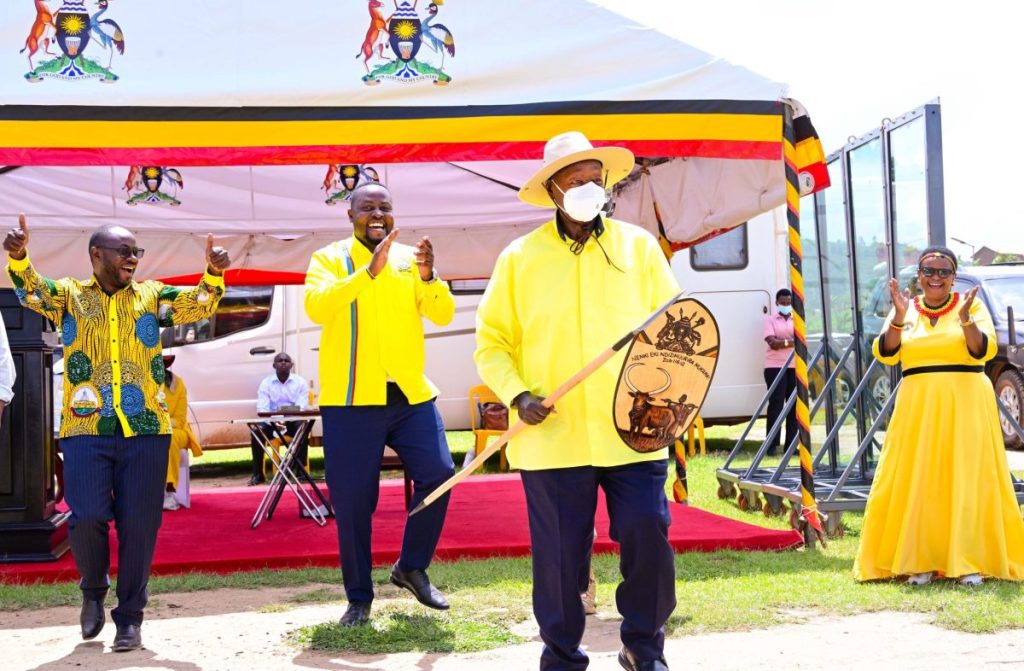
President Yoweri Kaguta Museveni has called on Ugandans to renew their trust in the National Resistance Movement (NRM) by evaluating the party’s performance over the past four decades, saying the party’s legacy is anchored in visible and tangible contributions that have transformed the country.

- Advertisement -
Addressing thousands of supporters on Tuesday 25th November 2025, at Rushebeya playground in Rushebeya Sub-County, Rukiga District, President Museveni, who is also the NRM presidential flag bearer, said Ugandans have every reason to vote for NRM because its record is grounded in achievements rather than promises.
“If you support NRM, you’re on the right path because NRM talks about the visible contributions it has made to Uganda,” President Museveni said, during his address that centered on peace, development, infrastructure, and wealth creation. The rally formed part of his ongoing campaign trail in Western Uganda as he seeks re-election in the 2026 general elections.
President Museveni placed peace at the top of what he called the “seven contributions of NRM,” arguing that national stability remains the most critical achievement of his government.
“What is important is to tell you the seven contributions of NRM, starting with peace. Uganda is peaceful because of NRM,” the President said.
- Advertisement -
He pointed to ongoing instability in neighbouring countries, particularly the Democratic Republic of Congo (DRC), where communities face daily insecurity. In contrast, he said, Ugandans have enjoyed decades of stability.
“Yesterday in Kisoro, people spoke about the suffering their neighbours in the DRC continue to face due to insecurity. Ugandans today enjoy stability because of the peace built over the years,” he added, emphasizing that peace has allowed the country to prioritize development, attract investment, and grow the economy.
The President said that when the NRM came into power in 1986, electricity supply in the western region was scarce and unreliable.
“When the NRM came into power, this side of Kabale had no electricity from Jinja. The power line stopped in Kasese, and Kabale relied on a small dam at Kariba,” President Museveni explained.
He noted that today, nearly the entire region is connected, with Rukiga boasting four of its six sub-counties on the national grid.
“Plans are underway to electrify Bukinda and Mparo sub-counties in the next term,” he said.
Regarding safe water access, President Museveni said he was pleased to learn that Rukiga now has 83% rural safe water coverage, supported by gravity flow schemes, solar-powered irrigation, rainwater harvesting systems, and ongoing sanitation upgrades.
President Museveni also credited the NRM government with transforming Uganda’s road network, particularly linking major regions and border points.
“We worked on the road network right from Kampala to Kabale up to the Katuna border. We also did the Kabale–Kisoro Road, then the road from Mbarara–Rukungiri–Kanungu up to Kihiihi,” he said.
He announced that new works will commence on the long-awaited Muhanga–Rwamucucu road, connecting Kamwezi, Rubale, Rukungiri, and eventually joining the Kanungu road. The announcement was met with loud applause, as road infrastructure remains one of Rukiga District’s key concerns.
In a candid moment, President Museveni addressed the challenges of balancing public expectations and limited government resources.
“I need you to help me with one thing—prioritization of resources, and to do one thing at a time, not everything at once,” he said, while defending the government’s decision to increase salaries for science teachers before addressing the demands of arts teachers.
“We increased the salaries of science teachers because we need them urgently. We need all teachers, but we have to prioritize what benefits everybody before returning to the arts teachers. But the arts teachers want the salaries now-now,” President Museveni said.
Drawing parallels with the military, he argued that the Uganda People’s Defence Forces (UPDF) prioritizes equipment and welfare over salaries.
“In the UPDF, we prioritize equipment and the welfare of soldiers, not salary. They don’t have good houses; they still sleep in grass-thatched homes. In other countries, they prioritize salary first – that is why they can’t defend themselves,” he added.
Environment and Irrigation:
President Museveni praised residents of Rukiga for protecting wetlands and avoiding environmental destruction.
“I thank you for not destroying the environment and keeping the swampy areas intact,” he said, promising a major government-funded irrigation project in the swamp to boost agricultural productivity.
“I’m going to start a big project on this swamp to enable you to start irrigation and get good yields like Dr. Muranga of Bushenyi,” the President said, highlighting Dr. Muranga’s success—harvesting 53 tons of bananas per acre annually—as evidence of what irrigation can achieve as opposed to 5 tons harvested by the rest of the people.
Household Wealth:
President Museveni revisited a recurring theme in his campaigns: the distinction between wealth (a personal economic gain) and development (public infrastructure and services).
“Development is for everyone—like roads, schools, hospitals. Wealth is personal and private,” President Museveni told the supporters, further reminding them that the wealth creation message began as early as the 1960s in the cattle corridor, long before he became President.