
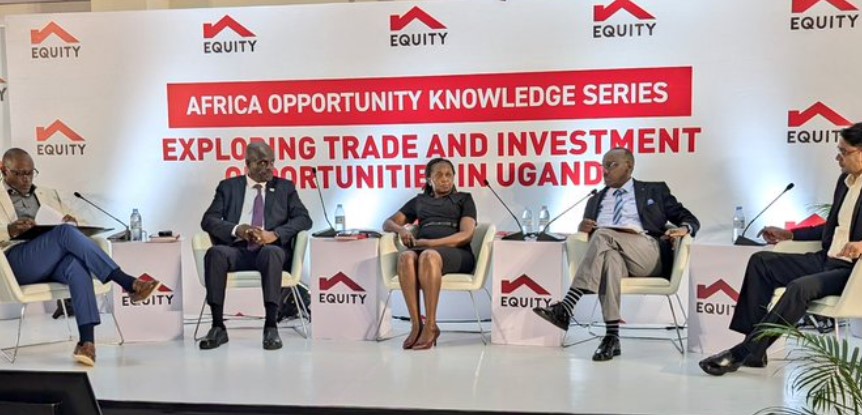
April 2026 : Equity Bank Uganda has held Knowledge Series, “Exploring Trade & Investment Opportunities in Uganda,”conevening more than 300 virtual and in-room participants, from international investors to local entrepreneurs, to unpack Uganda’s growth trajectory and the ecosystem of support that’s accelerating it.
- Advertisement -
Over three hours of presentations and panel discussions, speakers from Equity Bank, the Uganda Investment Authority (UIA), the Ministry of Trade, and the Private Sector Foundation Uganda (PSFU) wove a narrative of bold ambition, concrete reforms, and partnership-driven execution.
Claire Tumwesigye, Head of Marketing & Corporate Communications at Equity Bank Uganda, opening on behalf of MD Gift Shoko, declared, “We’re here to drive Africa’s socio-economic prosperity. Through platforms like this Knowledge Series, we spark dialogue, share actionable insights, and inspire collaboration to unlock Uganda’s vast economic potential.”
She highlighted Equity’s position as the second-largest bank in Uganda with more than 1.5 million customers and its active support for GDP drivers such as agriculture, manufacturing, tourism, health, and extractives. “As your financial intermediary, we stand ready to co-create solutions that catalyze growth in every sector,” she added.
“Uganda has been ranked Top Investment Destination in Africa and East Africa three years running,” said Rita Mugula, Deputy Director for Investment Promotion at UIA. “Our one-stop center cuts licensing time by up to 60 percent, and our bankable-projects booklet presents shovel-ready opportunities with detailed feasibility studies.”
According to UIA data, foreign direct investment has grown, with inflows jumping from US$666 million in 2020 to US$2.8 billion in 2024, a fourfold surge in five years. Uganda’s 47 million domestic consumers sit at the center of an East African Community of 300 million people, a COMESA bloc of 600 million, and, thanks to AfCFTA, access to 1.5 billion customers across the continent.
She spotlighted priority sectors—coffee processing, cotton revamping, agro-equipment assembly, eco-tourism lodges, mineral exploration (iron, gold, tin, cobalt), ICT parks, pharmaceuticals, and vocational-training institutes—each backed by incentives such as a ten-year income-tax holiday for exporters and R&D-cost deductibility.
“Building strong domestic competitiveness is the springboard for winning in export markets. Uganda’s deepening integration into regional blocs—the EAC Customs Union and Common Market (8 countries, 130 million people), COMESA Free Trade Area (21 countries, 600 million people), and the AfCFTA (54 countries, 1.4 billion people)—positions us to access vast markets with fewer barriers,” said Cleophas Ndoreyire, Commissioner of External Trade at Uganda’s Ministry of Trade, Industries, and Cooperatives.