
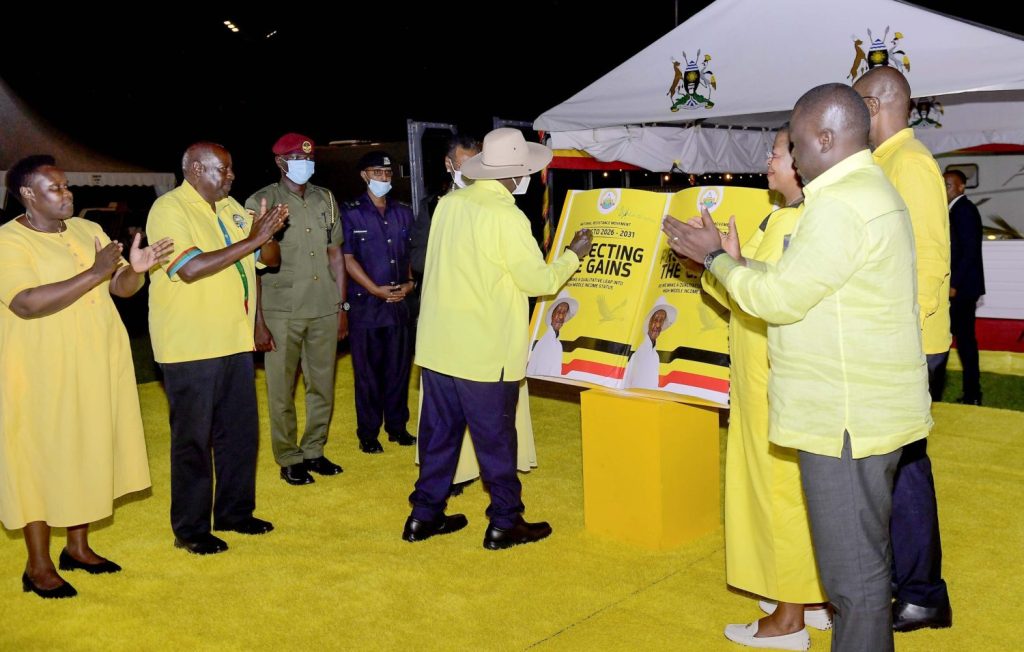
President Yoweri Kaguta Museveni, who is also the National Chairman of the ruling National Resistance Movement (NRM), has today officially launched the party’s manifesto for the 2026–2031 term.

- Advertisement -
At a grand ceremony hosted at Munyonyo Commonwealth Resort Hotel which drew Cabinet ministers, Members of Parliament, senior NRM officials, party secretariat leaders, under the theme: “Protecting the Gains and Securing a Qualitative Leap into High Middle-Income Status”, President Museveni retraced the NRM’s 60-year historical struggle while also laying out ambitious commitments for the next five years.
President Museveni expressed gratitude to the NRM delegates for once again entrusting him with leadership. He noted that the party had not only re-elected him as National Chairman for the 2025–2031 term but also nominated him as the flag bearer for the 2026 elections.
“I want to thank you for supporting my candidature, first of all, electing me Chairman of the NRM again for another five years, 2025 to 2031, and then also electing me as flag bearer,” H.E. Museveni said, reminding the gathering that the NRM’s role in Uganda’s liberation stretches back decades.
He described the liberation struggle between 1965 and 1986 as a decisive period when NRM leaders risked all to free the country from dictatorship and chaos.
- Advertisement -
The President declared that the NRM’s most important gift to Uganda has been peace and security, which has been assured largely by the people of Uganda—the wanainchi—and the Uganda People’s Defence Forces (UPDF).
“Our army is very strong. Nobody can bring war here. If you bring war here, we will destroy you,” he stated firmly, drawing applause.
President Museveni also cautioned that peace must be distinguished from security. He acknowledged that crime, particularly theft, continues to frustrate citizens and undermine the government’s development programs such as the Parish Development Model (PDM).
“People get money for PDM. They buy pigs, goats, chicken—they are stolen. And you find the policemen colluding with the thieves. The judiciary releases them. You leaders should not accept this in your areas,” President Museveni warned.
He urged leaders to enforce discipline and reject any culture of leniency towards crime.
“Any thief who steals properties of the villages must go to jail and stay there and pay for what he has stolen before he comes out. Be very strict—don’t play around.”
Beyond peace and security, President Museveni highlighted three pillars of Uganda’s transformation; development, infrastructure, and wealth creation.
He explained that development covers both economic and social infrastructure: roads, electricity, schools, hospitals, and ICT. Wealth creation, however, remains the key to consolidating the NRM’s legacy.
“You, the leaders, should really know that to strengthen the NRM more and durably, you must do what we in the student movement did in the 1960s when we started the campaign in the cattle corridor,” President recalled.
He narrated how the cattle corridor, once plagued by nomadism and poverty, was transformed through dairy farming campaigns into a prosperous region.
“Despite infrastructure challenges, regions like Ngoma and Matongo are now prosperous, with residents owning cars and having money,” H.E. Museveni said.
With 40 million acres of arable land, he stressed that Uganda has the capacity to create over 105 million jobs if even 7 million acres are properly utilized.
“There will be so many jobs that even refugees in the camps will get out and work,” he quipped.
On the matter of employment, President Museveni criticized the outflow of Ugandans to the Middle East in search of jobs. He insisted that Uganda has enough opportunities if productivity is maximized.
“People going to the Middle East to look for jobs—what are you going to look for? The Middle East should be coming here to work. You leave jobs here, you go to work in the Middle East,” he remarked, provoking laughter and nods among delegates.
The President also highlighted Uganda’s scientific innovations, especially in health. He said that Ugandan scientists have developed medicines for cancer, diabetes, malaria, and other global diseases.