
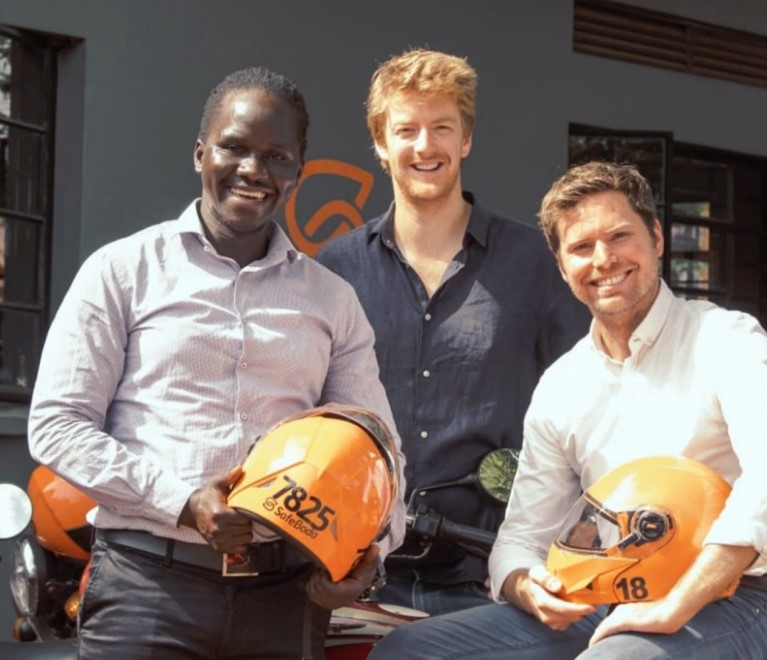
In 2014, a simple idea was born on the vibrant streets of Kampala – an idea and community that would transform Uganda’s boda boda industry forever and become a household name: SafeBoda. At the heart of this journey were three visionary co-founders: Ricky Rapa Thomson, Maxime Dieudonné, and Alastair Sussock.

- Advertisement -
Ricky Rapa Thomson, a determined and charismatic entrepreneur from Northern Uganda, had once worked as a security guard before becoming a boda boda rider. Known for his engaging nature, Ricky wasn’t just offering rides with a helmet, which was rare, he also was as a part-time tour guide showcasing the beauty of Kampala to visitors. But behind his vibrant hustle was a heavy heart – he had lost his best friend in a tragic road accident. This experience made Ricky care deeply about road safety and wanting a better organized and dignified boda boda Industry.
Just over 300 miles from Kampala, Maxime and Alastair were living and working in Rwanda when Maxime visited Kampala for the first time. He was struck by the chaotic state of the sprawling boda boda industry and the alarmingly low use of helmets—especially in contrast to the more organized system in Rwanda. Through a mutual friend, Maxime was introduced to Ricky. Shortly afterwards, he and Alastair took the overnight bus from Kigali to Kampala to meet Ricky and Moses Musinguzi—known as Namba Emu—who would go on to become SafeBoda’s very first driver, proudly wearing helmet number SB 1, along with a few other early team members. That weekend was the real start of SafeBoda!
Building a Dream from Scratch
- Advertisement -
The first SafeBoda “office” was a modest single room in Kyebando Central, where a single call center agent called Jackie used GPS to dispatch the nearest rider to a customer – an innovation that felt revolutionary at the time. Moses as the first driver embodied the SafeBoda dream. He grew with the company, rising through the ranks to become Head of Operations.
From these humble beginnings, the team worked hard, dividing roles, forming key partnerships with organizations like Shell Foundation, training riders and equipping them with the now-famous orange helmets and reflectors, and sharing their bold vision of a safer, more dignified boda boda industry. Drives in the community would sign up to a code of conduct. They signed up young Ugandan and Kenyan software engineers such as Cleave Masareka and Charles Muchene (now engineers at Expedia and Apple in the USA), among others to build the MVP App.
Throughout 2016 and 2017, SafeBoda began scaling its driver community, as interest in Greater Kampala’s vast, informal motorcycle taxi market—comprising over a million rides per day—grew among potential competitors. In 2018, global competitors entered the motorcycle ride-hailing space in Africa for the first time, eyeing Kampala as a key opportunity.
These global companies invested heavily, aiming to quickly dominate the market. Initially, the SafeBoda team was concerned. But instead of backing down, SafeBoda doubled down—launching an improved app, rapidly expanding driver base, and maintaining high standards of safety and training, including consistent helmet use. That year, SafeBoda grew significantly. The key was trust—SafeBoda was built by boda riders, for boda riders, with a deep understanding of the community it served.
This remarkable growth and resilience did not go unnoticed. SafeBoda’s success quickly caught the attention of prominent global investors, who recognized the company as a standout local champion with the potential to reshape urban mobility in Africa. Backers such as Gojek—Southeast Asia’s leading mobility and on-demand services platform—Allianz X, Unbound, Beenext, and Kingsway Capital, among many others, saw not just the strength of SafeBoda’s competitive edge, but the power of its mission. Their investment was a powerful validation: that a homegrown startup, born in the neighborhood of Kyebando in Kampala, could build a technology-driven solution capable of competing with the world’s biggest players. SafeBoda proved that local problems could be best addressed by local innovators—those who understand the community, the culture, and the unique dynamics of the market. SafeBoda showed that global relevance can be achieved by building authentically African solutions.